- Home
- Guides
- Licensed or not?
Licensed, non-licensed or notifiable: which asbestos work is which
The Control of Asbestos Regulations 2012 sort all work with asbestos into three categories. Which one your job falls into decides who may do it, what paperwork goes to HSE and a good part of the price. This is the plain English version, with HSE's own examples.
The three categories
The higher-risk materials: sprayed coatings, pipe and boiler lagging, loose fill insulation and most work on asbestos insulating board. Only a contractor holding an HSE licence may do it. Doing it without one is an offence.
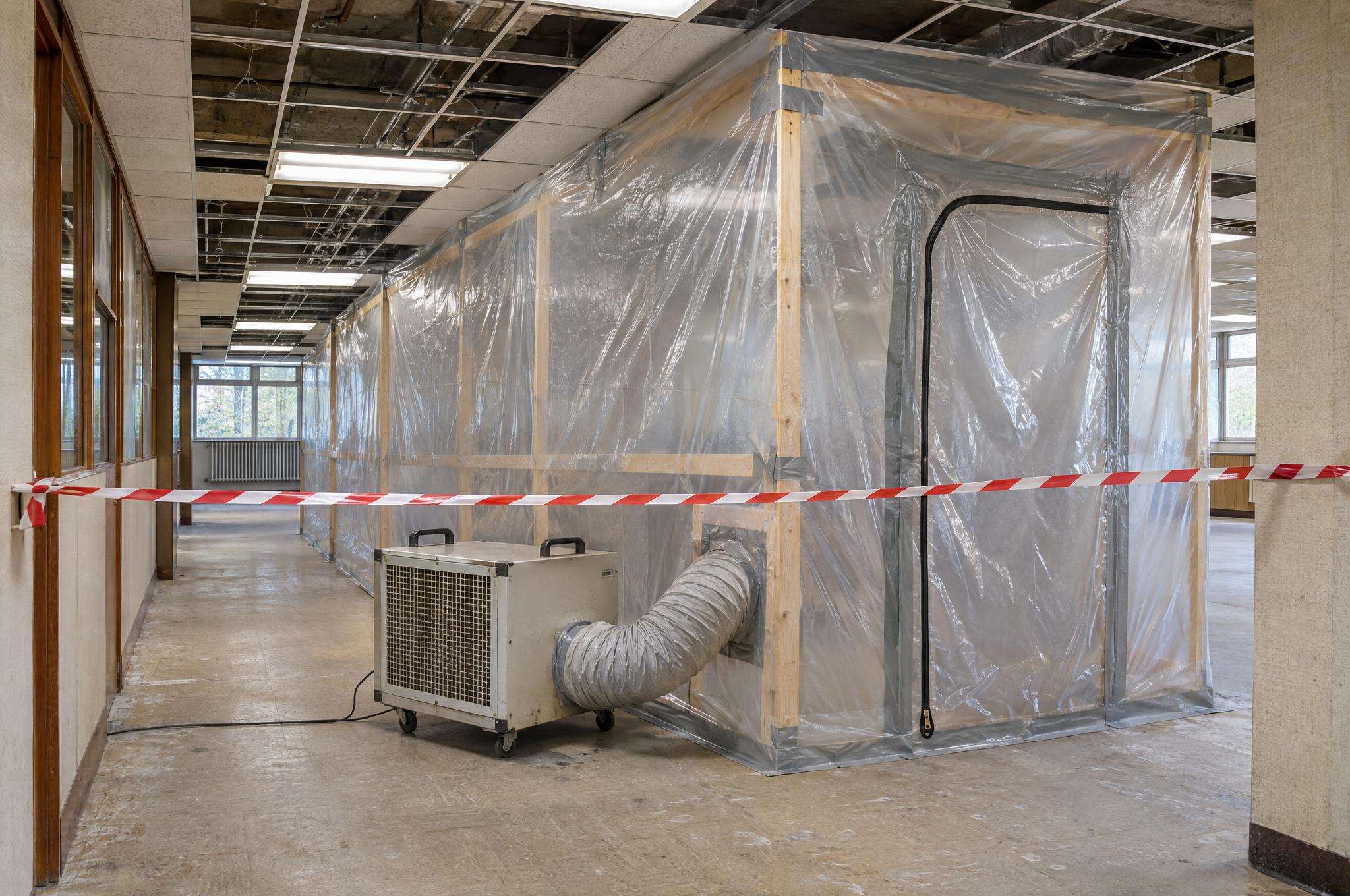
The contractor must tell HSE at least 14 days before starting, on a form called ASB5. The work is done inside a sealed enclosure. Afterwards an accredited analyst carries out a four-stage clearance, including air testing, and issues a certificate before anyone goes back in.
The middle band, usually shortened to NNLW. No licence is needed, but the job is risky enough that HSE wants to know about it. HSE's examples: asbestos cement that is substantially damaged or broken up, taking off textured coatings on a large scale by steaming or gelling, and short jobs on insulating board during a refurbishment.
The contractor has three extra duties: notify the enforcing authority online before work starts (there is no minimum notice), have workers medically examined every three years, and keep health records for 40 years.
The lower-risk jobs, where the fibres are firmly bound and the material stays whole: cement sheets and gutters removed carefully, floor tiles, small areas of textured coating, sealing material that is in good condition.
No licence and no notification. It is still regulated. The people doing it need training for non-licensed asbestos work, a written risk assessment and HSE's control methods, and the waste is hazardous waste.
By material
| Material and job | Category | Why |
|---|---|---|
| Asbestos cement sheets, gutters, flues, tanks, removed whole | Non-licensed | Fibres firmly bound in cement; handled carefully without breaking up |
| Asbestos cement that is badly damaged or breaks up as it is removed | Notifiable | The material is degraded, so the simple exemption no longer applies |
| Textured coating (Artex): drilling for fittings, small areas | Non-licensed | Short, low-exposure work with dust-reducing methods |
| Textured coating: large-scale removal by steaming or gelling | Notifiable | HSE’s own example of notifiable non-licensed work |
| Vinyl and thermoplastic floor tiles, bitumen adhesive, mastics, roofing felt | Non-licensed | Listed by HSE as non-licensed |
| Sealing or encapsulating material that is in good condition | Non-licensed | Listed in regulation 3(2) |
| Insulating board: short jobs under an hour, such as removing one screwed panel for access | Non-licensed | Short duration, or notifiable if part of a refurbishment |
| Insulating board: most removal | Licensed | Not short duration work |
| Pipe and boiler lagging, sprayed coatings, loose fill insulation | Licensed | High fibre release; HSE says licensed contractors only |
Summarised from HSE's pages on licensable work (updated 9 September 2024), notifiable non-licensed work (6 September 2024) and non-licensed work (23 February 2024), and regulations 2 and 3 of the Control of Asbestos Regulations 2012. Read 24 November 2026. The category of a real job is decided by the contractor's risk assessment, not by a table.
What decides it, in law
Work is licensable if exposure is not "sporadic and of low intensity", or if the risk assessment can't clearly show the control limit won't be exceeded, or if it is on asbestos coating, or on insulation or insulating board and isn't short duration. Two numbers sit behind that. The control limit is 0.1 fibres per cubic centimetre of air averaged over four hours. "Sporadic and of low intensity" means no more than 0.6 fibres per cubic centimetre measured over ten minutes. Short duration means no one person working for more than an hour, and no more than two hours in total, in any seven days.
Textured coatings such as Artex are specifically left out of the legal definition of "asbestos coating", which is why Artex work is never licensed work.
A change from November 2027
Amending regulations made on 2 November 2026 (SI 2026/1153) change who appoints the analyst for the clearance after removal. From 25 November 2027, the person who certifies the area fit for reoccupation can't be appointed by the contractor who did the removal. If you are the client on a licensed job after that date, expect to appoint the analyst yourself or through someone independent.
How many licence holders are based in Kent
We downloaded HSE's list of current licence holders dated 17 November 2026 and matched every registered postcode to its council. Great Britain has 369 licences held by 361 firms. 16 are at addresses in Kent or Medway. 15 of those are standard licences and one is a maintenance licence. None of the 28 scaffolding licences is held in Kent.
They aren't spread evenly. Sevenoaks district has four, Dartford three, Medway and Ashford two each, and Canterbury, Dover, Maidstone, Swale and Tonbridge and Malling one each. Gravesham, Tunbridge Wells, Folkestone and Hythe and Thanet have none.
For comparison, 50 holders are registered in Essex, 13 firms in London, and one each in East Sussex and Surrey. The register also labels four London addresses (Sidcup, Erith and Belvedere) as "Kent", which they haven't been since 1965.
What that means if you are buying
A registered address isn't a service area. Essex and London firms work in Kent every day and Kent firms work outside it, so a short local list is no reason to rule a firm out. What you should do, for licensed work only, is ask for the licence number and check the name and expiry date on the list. Licences are granted for a fixed term: one year for a first licence and normally three years on renewal. HSE can shorten, refuse or revoke one.
We don't name or rate the firms. The list is public and HSE links to it here.
Kent Asbestos Removal does not hold an HSE licence and isn't on that list. We pass enquiries to contractors. Work is carried out by licensed contractors where the law requires it.
| Council area | Built before 2000 | Share | Built 1965 to 1982 | HSE licence holders registered | |
|---|---|---|---|---|---|
| Thanet | 61,010 | 86.8% | 16.0% | 0 | |
| Gravesham | 38,760 | 85.8% | 16.5% | 0 | |
| Sevenoaks | 44,930 | 85.5% | 22.1% | 4 | |
| Dover | 46,990 | 84.3% | 16.9% | 1 | |
| Folkestone & Hythe | 45,170 | 84.2% | 18.7% | 0 | |
| Medway | 102,410 | 83.9% | 20.8% | 2 | |
| Tunbridge Wells | 44,030 | 83.5% | 19.4% | 0 | |
| Canterbury | 56,940 | 78.6% | 18.0% | 1 | |
| Swale | 51,980 | 77.4% | 18.4% | 1 | |
| Tonbridge and Malling | 43,490 | 75.0% | 17.3% | 1 | |
| Maidstone | 57,890 | 73.7% | 18.9% | 1 | |
| Ashford | 42,470 | 71.8% | 20.0% | 2 | |
| Dartford | 35,980 | 70.5% | 9.1% | 3 | |
| Kent and Medway | 672,050 | 80.1% | 18.2% | 16 | |
| England | 20,858,840 | 81.1% | 18.2% | n/a |
Housing: Valuation Office, Council Tax: stock of properties 2026, table CTSOP4.1 (as at 31 March 2026, published 24 September 2026). Shares are of homes with a known build period. Licence holders: HSE's list of current asbestos licence holders dated 17 November 2026, published by CONIAC, counted by us from each holder's registered postcode. A registered address is not a service area: firms travel.
Licence fee and terms: HSE asbestos licensing pages. The assessment fee for a licence is £3,683. Source for counts: HSE's list of current asbestos licence holders dated 17 November 2026, published by CONIAC.
Licence questions
Does a garage roof need a licensed contractor?
No. Asbestos cement removed whole is non-licensed work. The contractor still needs training for non-licensed asbestos work, a risk assessment and proper controls, and must move the waste as hazardous waste. If the sheets are badly broken up, the work becomes notifiable.
How do I check a contractor’s HSE licence?
HSE’s “Find a licensed asbestos contractor” link goes to a spreadsheet of current licence holders published by CONIAC. Look up the firm’s name, licence number and expiry date. The list we used is dated 17 November 2026. A licence, or a copy, must also be displayed at every site where licensed work is done.
What does notifiable non-licensed work mean for me as the customer?
Very little changes for you. The contractor has to notify the enforcing authority online before the work starts, keep a health record of who did the work and have those workers under medical surveillance. You can ask to see the notification.
Is UKATA or ARCA membership the same as a licence?
No. They are training and trade bodies. Membership or a training certificate can show that people have been trained, but only HSE issues asbestos licences. This site holds none of them: we pass enquiries to contractors who do.
Do you legally have to report asbestos?
There is no general duty to report that a building contains asbestos. Contractors must notify HSE before licensed work (14 days ahead) and before notifiable non-licensed work. People responsible for non-domestic premises must keep a register and tell anyone who might disturb the material.