- Home
- Removal
- Homes
Domestic Asbestos Removal in Kent
Eight in ten Kent homes were built before asbestos was banned. Most of what turns up in them is low-risk cement product. Some of it is board or lagging that only an HSE-licensed contractor may remove. This page sorts one from the other.
How the law classes this work
- Non-licensed workCement soffits, flues, tanks, gutters
- Licensed workInsulating board, lagging, loose fill
Where it is in a house
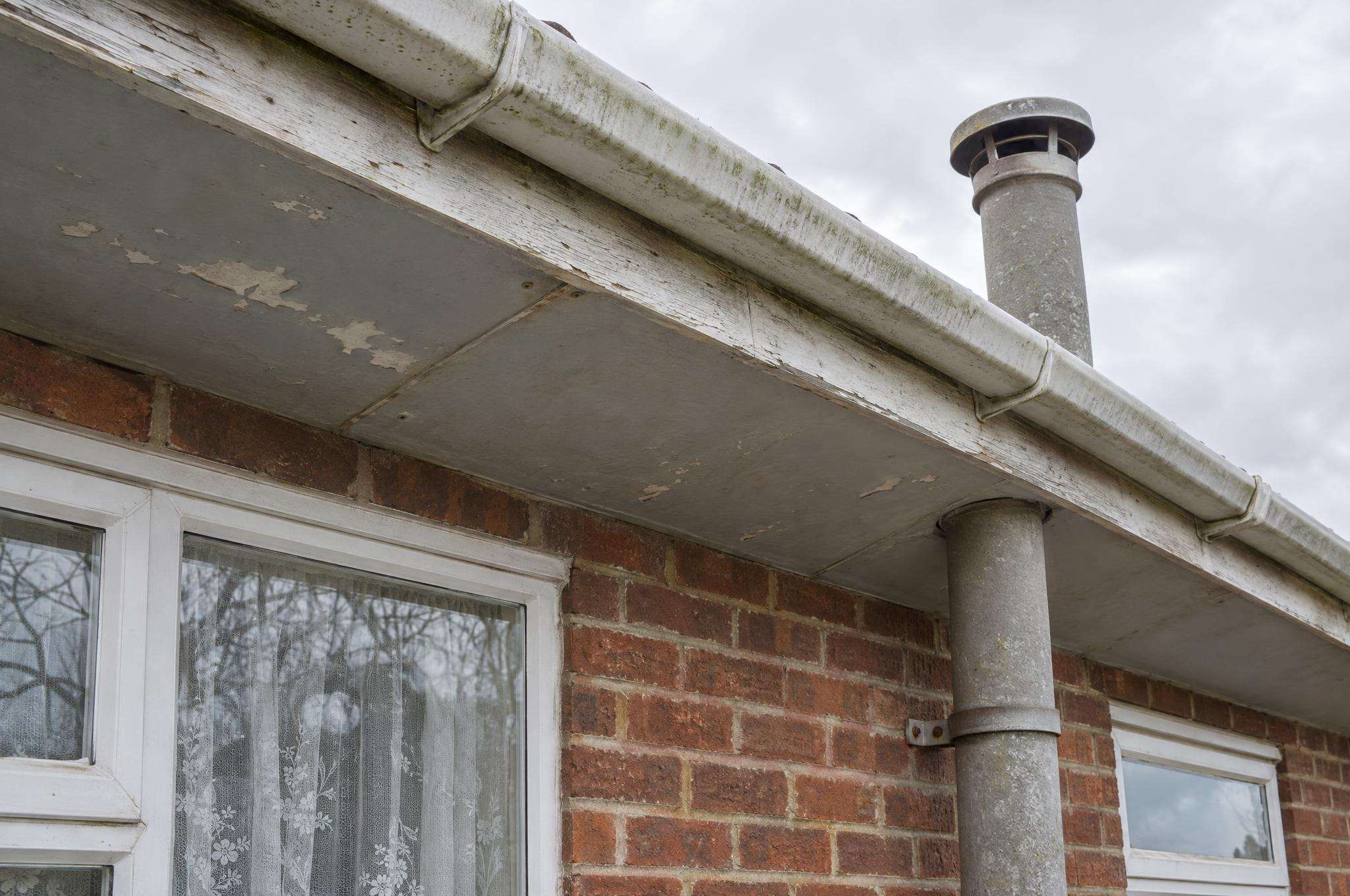
HSE’s residential diagram lists the usual places. Outside: soffits and fascias, roofing felt, cement roof slates, cement panels, corrugated sheeting, gutters and downpipes. Inside: board around the boiler and in the airing cupboard, behind the fire and the fuse box, bath panels, ceiling tiles, partition walls, pipe lagging, the loft water tank, loose fill insulation, floor tiles and textured coatings.
Garage roofs, textured ceilings and floor tiles each have their own page. The rest are here.
The cement ones
Soffit boards, flue pipes, gutters, downpipes and cold water tanks were very often made of asbestos cement. Taken out whole they are non-licensed work. A trained contractor does these in hours, and they are priced in hundreds of pounds.
Soffits are the awkward case. Painted cement board and painted insulating board look the same from the ground, and the second is licensed work. Have a sample tested before you accept a price.
The ones that need a licensed contractor
HSE’s advice to householders is direct: "Some materials (sprayed asbestos coatings, asbestos lagging / insulation or asbestos insulating board) should only be removed by a contractor licensed by HSE." Loose fill insulation in a loft is in the same group.
Licensed work is slower and dearer for good reasons. The contractor gives HSE 14 days’ notice, builds a sealed enclosure, and an independent analyst carries out a four-stage clearance with air testing before the area is handed back. Our plain English guide explains the three legal categories, and how to check a licence yourself.
When leaving it alone is right
HSE says "Left alone and in good condition, the risk from asbestos is low." A disused cement tank in the loft, a sound flue or intact soffits don’t have to come out because you’ve learned what they are. They do need dealing with before building work disturbs them, or if they are damaged.
Kent Asbestos Removal is an enquiry service and holds no HSE licence or accreditation of its own. Your enquiry goes to an approved local asbestos contractor. Work is carried out by licensed contractors where the law requires it.
Where Kent’s pre-2000 homes are
80.1% of homes in Kent and Medway, 672,050 in all, were built before the last type of asbestos was banned on 24 November 1999. The share runs from seven in ten to nearly nine in ten depending on the council.
| Council area | Built before 2000 | Share | Built 1965 to 1982 | HSE licence holders registered | |
|---|---|---|---|---|---|
| Thanet | 61,010 | 86.8% | 16.0% | 0 | |
| Gravesham | 38,760 | 85.8% | 16.5% | 0 | |
| Sevenoaks | 44,930 | 85.5% | 22.1% | 4 | |
| Dover | 46,990 | 84.3% | 16.9% | 1 | |
| Folkestone & Hythe | 45,170 | 84.2% | 18.7% | 0 | |
| Medway | 102,410 | 83.9% | 20.8% | 2 | |
| Tunbridge Wells | 44,030 | 83.5% | 19.4% | 0 | |
| Canterbury | 56,940 | 78.6% | 18.0% | 1 | |
| Swale | 51,980 | 77.4% | 18.4% | 1 | |
| Tonbridge and Malling | 43,490 | 75.0% | 17.3% | 1 | |
| Maidstone | 57,890 | 73.7% | 18.9% | 1 | |
| Ashford | 42,470 | 71.8% | 20.0% | 2 | |
| Dartford | 35,980 | 70.5% | 9.1% | 3 | |
| Kent and Medway | 672,050 | 80.1% | 18.2% | 16 | |
| England | 20,858,840 | 81.1% | 18.2% | n/a |
Housing: Valuation Office, Council Tax: stock of properties 2026, table CTSOP4.1 (as at 31 March 2026, published 24 September 2026). Shares are of homes with a known build period. Licence holders: HSE's list of current asbestos licence holders dated 17 November 2026, published by CONIAC, counted by us from each holder's registered postcode. A registered address is not a service area: firms travel.
Questions people ask
What are the first signs of asbestos in a house?
There aren’t signs in the usual sense. Asbestos materials look like ordinary cement, board, tiles and textured paint. The clues are the age of the house (before 2000) and the places HSE lists: garage and shed roofs, soffits, flues, boiler cupboards, floor tiles, textured ceilings. A laboratory test confirms it.
I’ve found something I think is asbestos. What should I do?
Leave it alone and don’t drill, sand or break it. If it is damaged, keep people away from it. Then get a sample tested or a survey done. HSE’s asbestos questions page gives the same advice, and gov.uk/asbestos-in-home points you to your council.
Can you sell a house if you know it has asbestos?
Yes. Most pre-2000 houses contain some. Buyers and their surveyors want to know what it is, where it is and what condition it is in, which is what a survey report gives them.
Do I legally need an asbestos survey for my own home?
No. The legal duty to manage asbestos covers non-domestic premises and the shared parts of flats, not a private house. A survey becomes necessary in practice before refurbishment or demolition, because the builders have legal duties and need to know what they will disturb.
Homes near you
- Maidstone
- Medway
- Canterbury
- Ashford
- Tunbridge Wells
- Tonbridge and Malling
- Sevenoaks
- Dartford
- Gravesend
- Thanet
- Dover and Deal
- Folkestone and Hythe
- Sittingbourne, Faversham and Sheppey
Also: Garage roofs and sheds, Artex and textured ceilings, Floor tiles, Commercial premises, licensed or not?, costs.